Sunday, January 24, 2016

How Long Does it Take to Build a Mobile App?

“How long does it take to build a mobile app?” While the question isn’t as timeless as “How many licks does it take to get to the center of a Tootsie Pop?” (spoiler alert: 3481), it is one that’s very dear to our community of mobile app developers. And now we’ve got an answer. 18 weeks.

How long does it take to build an app infographic

Click image for full sized version
If you’d like to embed this infographic on your own site or blog, here’s the embed code:

In collaboration with research firm AYTM, we surveyed 100 mobile designers to discover how long they expected it would take to build core front- and backend components of an Android or iOS app.  We averaged the responses and then teamed with the designers at Visual.ly to visualize the time required to develop each component of an MVP-quality native app.

For fun, we put app development time in context. Who knew you could drill three 3000-foot oil wells in the time it takes to launch the first version of your “drill for oil” iOS game?

Of course, there’s a subtext to this graphic. Specifically, it doesn’t have to take 18 weeks to build v1 of your app. It can take a lot less time. The backend alone is estimated to require 10 weeks, but a backend as a service like Kinvey can dramatically reduce that time. And our SDK partners, like Adobe PhoneGap, BrightCove and Trigger.io, can all help accelerate your frontend development efforts as well.

So, how long would it take you to develop a native app MVP?

Kelly Rice

How Long Does it Take to Build a Mobile App?

Wednesday, January 20, 2016

Ninth Planet May Exist Beyond Pluto, Scientists Report

 There might be a ninth planet in the solar system after all, and it is not Pluto.

Two astronomers reported on Wednesday that they had compelling signs of something bigger and farther away — something that would satisfy the current definition of a planet, where Pluto falls short.

“We are pretty sure there’s one out there,” said Michael E. Brown, a professor of planetary astronomy at the California Institute of Technology.

What Dr. Brown and a fellow Caltech professor, Konstantin Batygin, have not done is actually find that planet, so it would be premature to start revising mnemonics of the planets.

In a paper published in The Astronomical Journal, Dr. Brown and Dr. Batygin lay out a detailed circumstantial argument for the planet’s existence in what astronomers have observed — a half-dozen small bodies in distant elliptical orbits.

What is striking, the scientists said, is that the orbits of all six loop outward in the same quadrant of the solar system and are tilted at about the same angle. The odds of that happening by chance are about 1 in 14,000, Dr. Batygin said.

A ninth planet could be gravitationally herding them into these orbits.

For the calculations to work, the planet would be at least an equal to Earth, and most likely much bigger — perhaps a mini-Neptune with a mass about 10 times that of Earth. That would be 4,500 times the mass of Pluto.

Pluto, at its most distant, is 4.6 billion miles from the sun. The potential ninth planet, at its closest, would be about 20 billion miles away; at its farthest, it could be 100 billion miles away. One trip around the sun would take 10,000 to 20,000 years.

“We have pretty good constraints on its orbit,” Dr. Brown said. “What we don’t know is where it is in its orbit, which is too bad.”

Alessandro Morbidelli of the Côte d’Azur Observatory in France, an expert in dynamics of the solar system, said he was convinced. “I think the chase is now on to find this planet,” he said.

This would be the second time that Dr. Brown has upended the map of the solar system. In January 2005, he discovered a Pluto-size object, now known as Eris, in the Kuiper belt, the ring of icy debris beyond Neptune.

The next year, the International Astronomical Union placed Pluto in a new category, “dwarf planet,” because in its view, a full-fledged planet must be the gravitational bully of its orbit, and Pluto was not.

The first indication of a hidden planet beyond Pluto had come a couple of years earlier. The Kuiper belt extends outward from Neptune’s orbit, about 2.8 billion miles from the sun, to a bit less than twice Neptune’s orbit, about five billion miles.

Astronomers expected that beyond lay mostly empty space.

Thus they were surprised when Dr. Brown and two colleagues spotted a 600-mile-wide icy world at a distance of eight billion miles that remained well outside the Kuiper belt even at the closest point in its orbit.

No one could convincingly explain how the object, which Dr. Brown named Sedna, got there, and the hope was that the discovery of more Sedna-like worlds would provide enlightening clues.

Instead, astronomers looked and found nothing, deepening the mystery.

Finally, in 2014, Chadwick Trujillo, who had worked with Dr. Brown on the Sedna discovery, and Scott S. Sheppard, an astronomer at the Carnegie Institution for Science in Washington, reported a smaller object in a Sedna-like orbit, always remaining beyond the Kuiper belt.

Dr. Trujillo and Dr. Sheppard noted that several Kuiper belt objects had similar orbital characteristics, and they laid out the possibility of a planet disturbing the orbits of these objects. “It was the best explanation we could come up with,” Dr. Trujillo said.

But the particulars of their proposed planet did not explain what was in the sky, Dr. Brown said.

“The theorists didn’t really take it seriously,” he said. “They figured it was all some observational effect. The observers didn’t take it seriously, because they figured it was all some theoretical thing they couldn’t understand.”

Still, the peculiarities of the orbits appeared genuine.

Dr. Brown said he and Dr. Batygin “sat down and beat our heads against the wall for the last two years.”

First, they focused on the six objects in stable orbits and disregarded others that had been recently flung out by Neptune.

That made the picture clearer.

“They all point into the same overall direction,” Dr. Batygin said. “This is in stark contrast with the rest of the Kuiper belt.”

Besides the long odds of this alignment being coincidental, Dr. Batygin said, this pattern would disperse over time.

That argued for the force of some unseen body guiding Sedna and the others.

Dr. Batygin, a theorist, tried placing a planet among them, which scattered some Kuiper belt objects, but the orbits were not sufficiently eccentric.

Then he examined what would happen if a ninth planet were looping outward in the opposite direction. That, Dr. Batygin said, gave “a beautiful match to the real data.”

The computer simulations showed that the planet swept up the Kuiper belt objects and placed them only temporarily in the elliptical orbits. Come back in half a billion years, Dr. Brown said, and Sedna will be back in the Kuiper belt, while other Kuiper belt objects will have been pushed into elliptical orbits.

Another strange result in the simulations: A few Kuiper belt objects were knocked into orbits perpendicular to those of the planets. Dr. Brown remembered that five objects had been found in perpendicular orbits.

“They’re exactly where we predicted them to be,” he said. “That’s when my jaw hit my floor. I think this is actually right.”

Dr. Morbidelli said a possible ninth planet could be the core of a gas giant that started forming during the infancy of the solar system; a close pass to Jupiter could have ejected it. Back then, the sun resided in a dense cluster of stars, and the gravitational jostling could have prevented the planet from escaping to interstellar space.

“I think they’re onto something real,” he said. “I would bet money. I would bet 10,000 bucks.”

CONTINUE READING THE MAIN STORY
25
COMMENTS
Dr. Brown said he began searching for the planet a year ago, and he thought he would be able to find it within five years. Other astronomers will most likely also scan that swath of the night sky.

If the planet exists, it would easily meet the definition of planet, Dr. Brown said.

“There are some truly dominant bodies in the solar system and they are pushing around everything else,” Dr. Brown said. “This is what we mean when we say planet.”

Correction: January 20, 2016
An earlier version of an animation accompanying this article carried an incorrect credit. It was made by Michael E. Brown, not Michael E. Clark.


An artist’s impression of a possible ninth planet. It would be quite large — at least as big as Earth — with a thick atmosphere around a rocky core. CreditCalifornia Institute of Techonology


Ninth Planet May Exist Beyond Pluto, Scientists Report

Monday, December 14, 2015

Asteroid to pass Earth on Christmas Eve | Science Wire | EarthSky

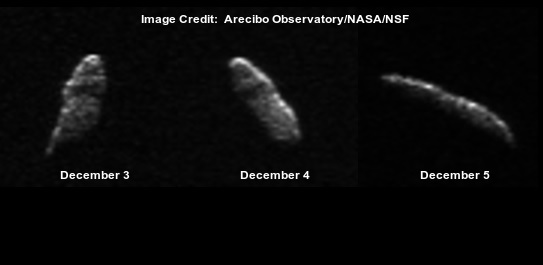
A large asteroid is approaching the Earth-moon system and will provide a good opportunity for radar observations in the days ahead. Asteroid 163899 – also known as 2003 SD220 – will come closest to Earth on Christmas Eve (December 24, 2015). It’ll pass at a safe distance, and there’s no need to worry about reports claiming it will skim the Earth, or cause earthquakes. At its closest, asteroid 2003 SD220 will be some 6,787,600 miles (11 million km) from our planet’s surface. That’s more than 28 times the Earth-moon distance! It’s so far away that only professional and advanced amateur astronomers are likely to capture optical images of this space rock.

Don’t believe any media suggesting that this space rock may cause earthquakes. Those assertions are misleading and incorrect. Even if 2003 SD220 were passing closer, it’s doubtful earthquakes would result. In fact, there’s no scientific evidence that an asteroid’s flyby can cause any seismic activity, unless it collides with Earth, but – in this case – that clearly will not be the case.

This asteroid isn’t a newly discovered object. Its name – 2003 SD220 – indicates its discovery year. The Lowell Observatory Near-Earth Object Search (LONEOS) program in Flagstaff, Arizona discovered the asteroid on September 29, 2003.

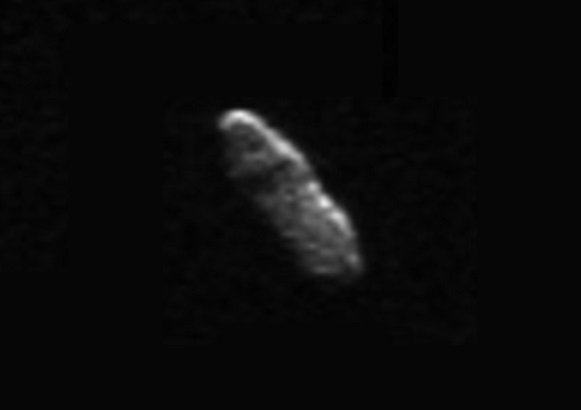
One notable feature of this asteroid is its large size. Preliminary estimates suggested a size of 0.7 miles to 1.5 miles (1.1 km to 2.5 km). Now the size estimate has been bumped up, after recent radar observations from the Arecibo telescope in Puerto Rico. The new observations suggest the asteroid is about 1.25 miles (2 km) long.

The asteroid is thought to have a very slow rotation of about one week.

Although some other asteroids such as 2015 TB145 (the Halloween asteroid) and 2004 BL86 (January, 2015) were visible using 8″ telescopes, the Christmas asteroid will be much more difficult to see because of its distance.

However, using radio telescopes, astronomers are already observing this asteroid by bouncing radio signals from the space rock’s surface. The Arecibo Observatory in Puerto Rico is studying asteroid 2003 SD220 from December 3 to 17, while the Goldstone Antenna in California is analyzing the space rock from December 5 to 20.

Image credit: Arecibo Observatory/NASA/NSF

Image via Arecibo Observatory/NASA/NSF
This space rock – whose shape can be compared to a chicken tender – will make its approach to Earth on December 24, 2015 but will return again in 2018. NASA astronomer and asteroid expert Lance Benner said in a Goldstone radar observations planning document:

2003 SD220 is on NASA’s NHATS list of potential human-accessible targets, so observations of this object are particularly important.

The 2015 apparition is the first of five encounters by this object in the next 12 years when it will be close enough for a radar detection.
The Near-Earth Object Human Space Flight Accessible Targets Study (NHATS) is a program developed to identify those near-Earth objects that may be well-suited for future human-space-flight rendezvous missions.

Although this is a huge asteroid, there is no danger of a future collision. The orbit of asteroid 2003 SD220 is well known and NASA has verified that the space rock will not pass at any dangerous distance during the next two centuries.

Image via NASA

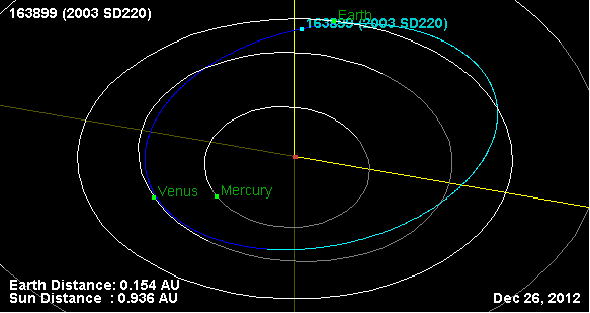
The path of asteroid 2003 SD220 through our solar system. Image via NASA
Bottom line: Asteroid 163899 – aka 2003 SD220 – will pass safely, at more than 28 times the Earth-moon distance, on December 24, 2015. Astronomers at Arecibo in Puerto Rico and Goldstone in California are taking this opportunity to study it with radar as it approaches. It’ll pass too far away to be visible in small amateur telescopes. Media reports suggesting that this space rock may cause earthquakes are misleading and incorrect.


Image credit: Arecibo Observatory/NASA/NSF

Image via Arecibo Observatory/NASA/NSF


Asteroid 163899 – aka 2003 SD220 – will pass safely, at more than 28 times the moon’s distance. Assertions it’ll cause earthquakes are misleading and incorrect.

Asteroid to pass Earth on Christmas Eve | Science Wire | EarthSky

Thursday, November 05, 2015

SPACE PHONE: Puerto Rico's Arecibo Observatory

Of the many reasons to visit Puerto Rico: tropical climate, Caribbean cuisine and Latin Music, only one is truly out of this world.

When Earthlings finally make contact with an intelligent alien civilization, odds are, the conversation will originate from Puerto Rico's historic Arecibo Observatory, the world's largest single-aperture telescope.

2015-11-04-1446603977-3588024-IMG_6417.JPG
In the not too distant future, when some hero scientist discovers a giant meteor hurtling towards Earth (hopefully) BEFORE it delivers a fiery knock out punch to life as we know it, this is where they'll sound the alarm. When yet another smarty-pants surveys the signature wavelengths bouncing off a far away planet and confirms the presence of liquid water and oxygen similar to habitat here on Earth, these are the screens that will announce those momentous results.

2015-11-04-1446604051-9242040-IMG_6430.jpg
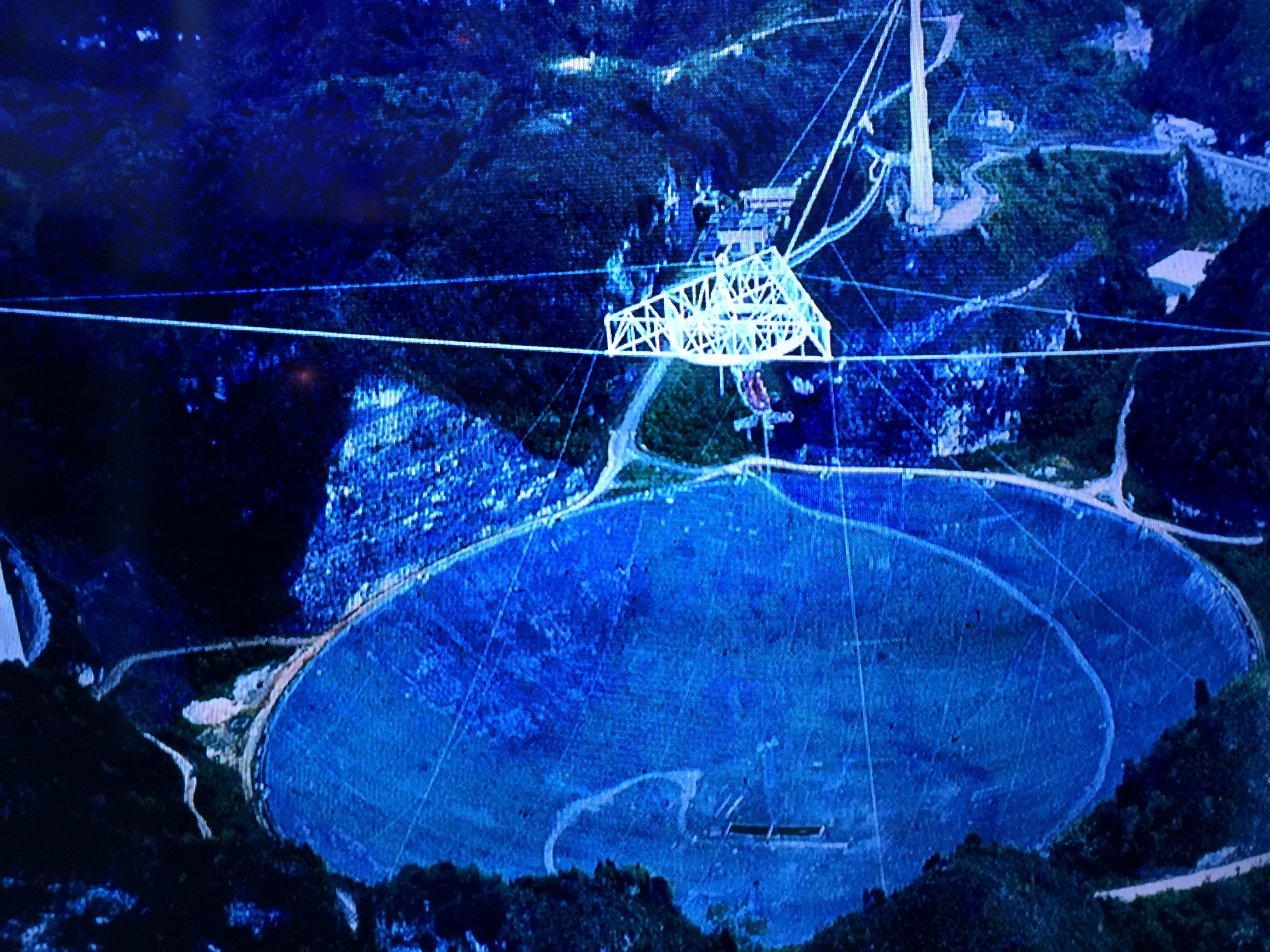
This National Science Foundation radio telescope, located a mountainous 40-minute, mostly freeway drive, from downtown San Juan, is the same facility featured in the Jody Foster/Carl Sagan movie Contact. It's also the home for the SETI@home project, Earth's most organized and scientific crowd-sourced Search for Extra Terrestrial Intelligence. It is, quite simply, the super bowl of Space Exploration. And it looks like it.

2015-11-04-1446604298-9007614-IMG_1814.jpg
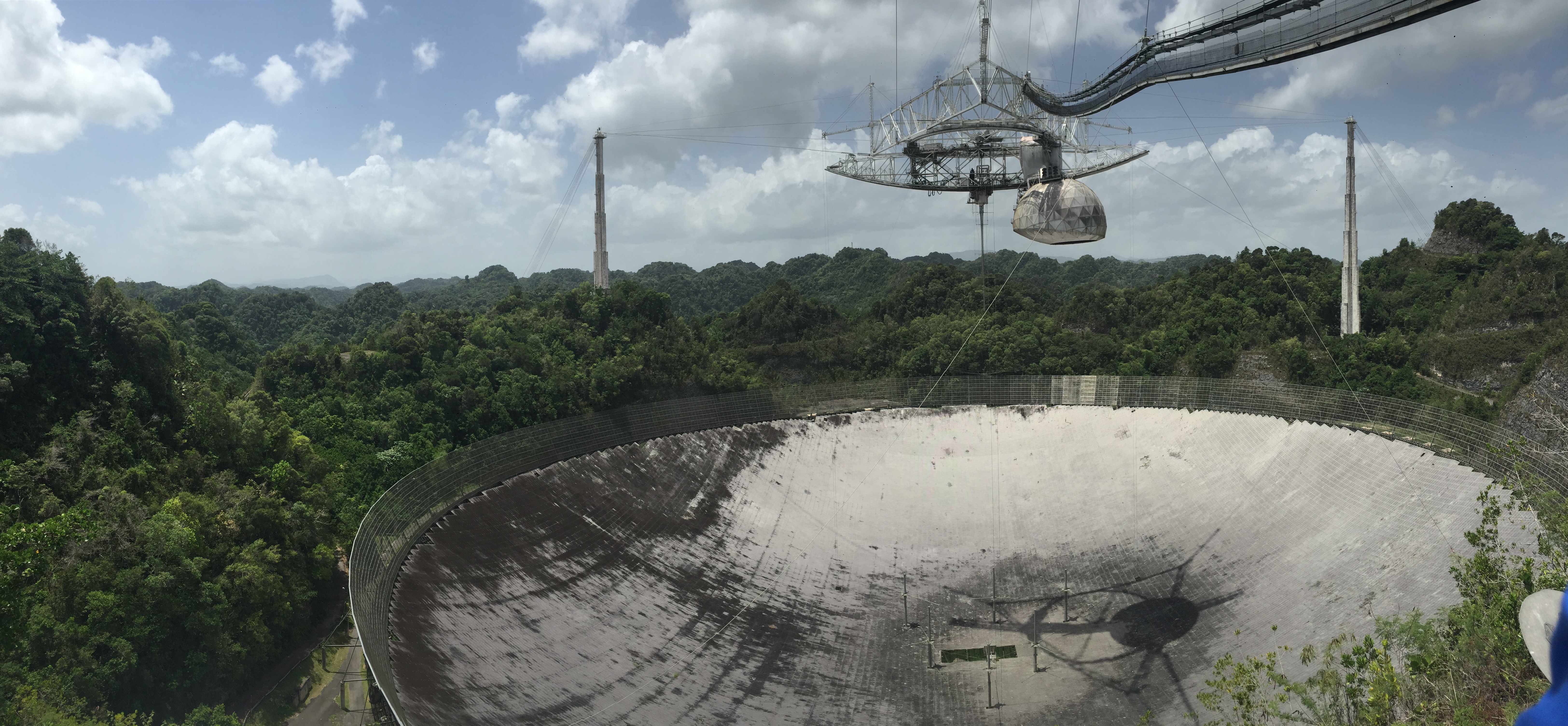
Completed in 1963, the dish and its collectors are suspended by enormous grid wires strung across a natural bowl high in the mountains of northern Puerto Rico. The major update completed on the facility in 1974 has lead to many amazing space discoveries, including the Nobel Peace Prize winning discovery of the first binary pulsar by Hulse and Taylor. In 1989, the Observatory directly imaged an asteroid for the first time in history.

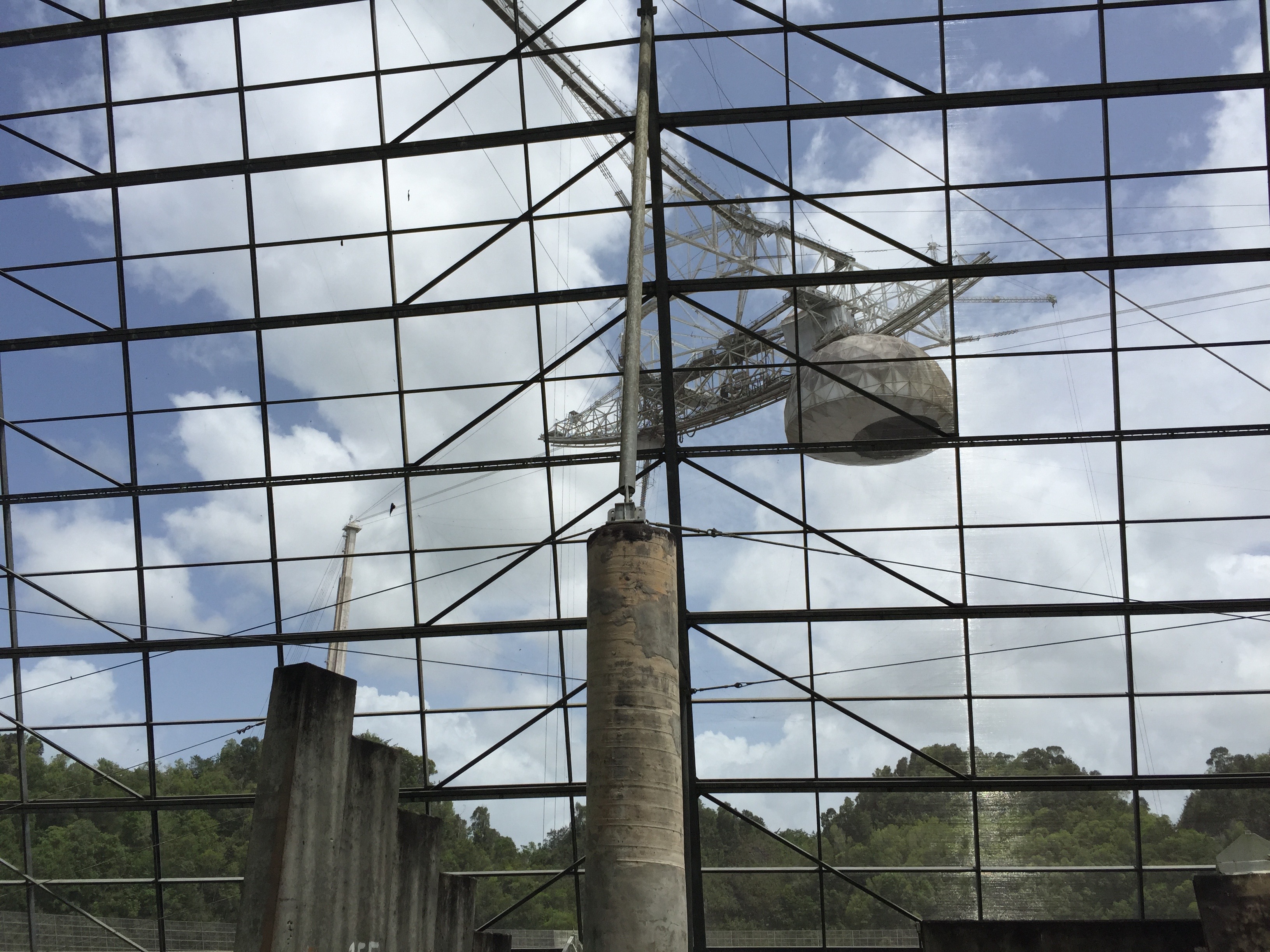
Even if you've seen photos of the telescope's radio dish, it's sheer size - 1000 fit across - must been experienced in person to appreciate. The bowl of the dish is made up of metal mesh, arrayed as a spherical reflector that collects radio waves from all over the universe and focuses them on the Gregorian Sub-Reflector suspended 500 feet above. The deluge of data streams across the gantry into the nearby control room where men and women with doctoral degrees, and kick ass Star Wars Halloween costumes, sift through the noise, listening and looking for... something. Anything; a coherent signal, a chemical signature - an "I'll know it when I see it" anomaly that in all probability would reward it's finder with a Nobel Prize.

Today, Arecibo is the focal point for the three major prongs of Earth's deep space research; Radio Astronomy, Atmospheric Science and Radar Astronomy. And you learn about all of it on your own tour.

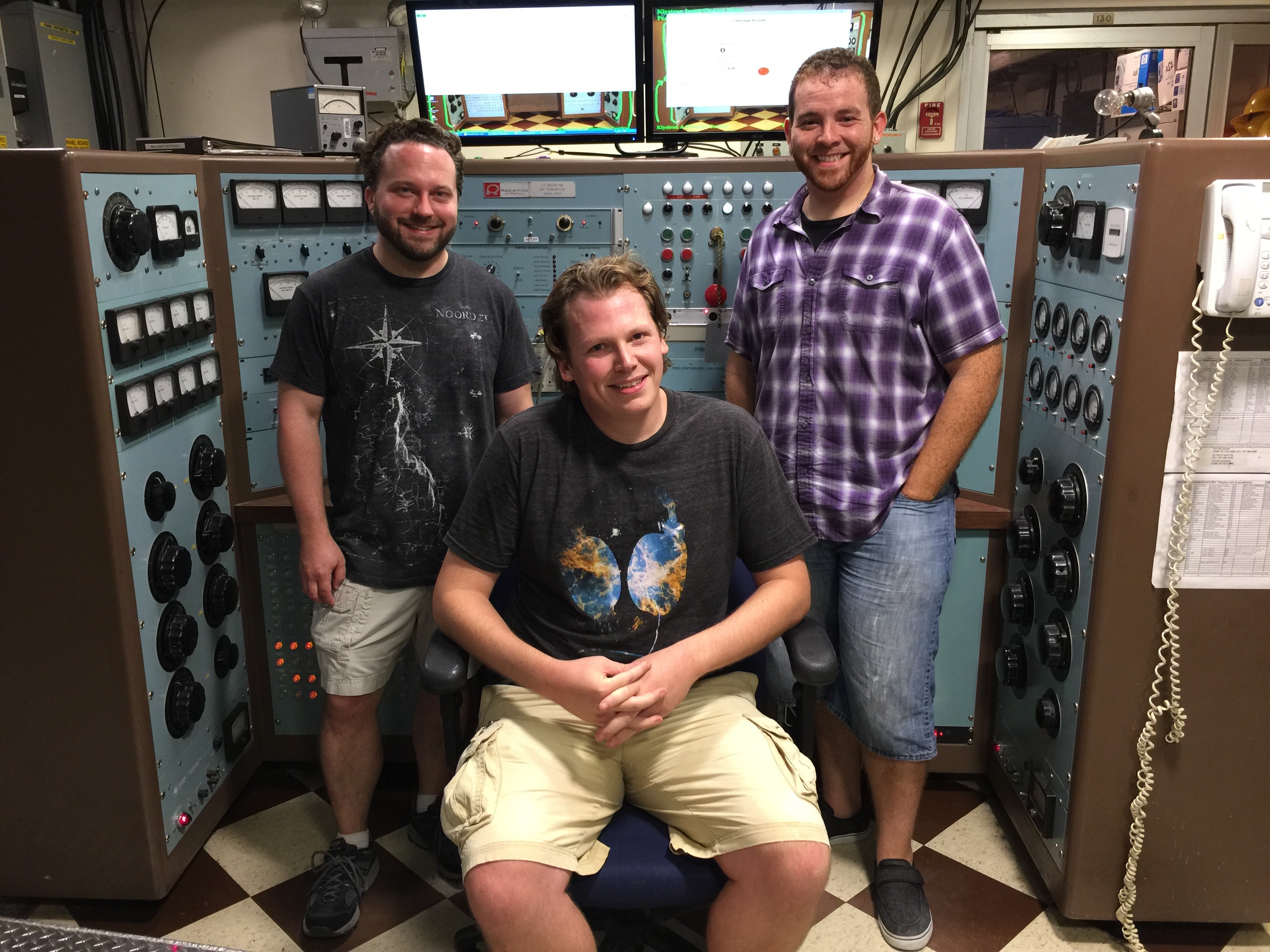
Our tour was led by three of the leading space researchers working today, (l-r) Astronomy PhD Patrick Taylor, Andrew Seymour, the Physics Phd and Space & Planetary Science Phd Edgard Rivera-Valentin.

2015-11-04-1446604396-9644142-docs2.jpg
These guys, who look more like Ultimate Frisbee intramural players than the guys responsible for saving Earth from, well... everything we'd need saving from, took us on an amazing walking tour down into the ravine and under the dish.

They are each focused on their own speciality, actively teasing out the secrets of the Cosmos, much like Carl Sagan, the Cornell University professor who brought his wonder and excitement of space to the rest of us. Sagan was involved in the early history of Arecibo, which is one of the reasons the wonderful film CONTACT was shot on location here. Another is... there's no place else like it on Earth.

2015-11-04-1446604585-1784241-IMG_1835.jpg
The Space Men took us on an hour-long tour of the facility and dish, and put up with far more stupid questions from me than they should have had to endure over a holiday weekend. The important take away, in layman's terms, is the rest of us are in good hands because these guys - and thousands of other men and women around the world working in similar fields - are crusading to squeeze amazingly esoteric truths from Terabytes of ones and zeroes. The kinds of truths that will one day, not maybe, but absolutely, save our planet.

Where do these uber-geniuses come from? The Dish. If you build it, they will come. Arecibo acts like a magnet, drawing in space nerds and crazy thinkers from all over the world to sit behind the wheel and study in its shadow.

On our walk they explained how Arecibo helps find new planets by their 'wobble,' new ways to spot NEO's [near Earth objects] before its too late, and nurture the next generation of scientists. Far as I could tell, they're Magna Cum Laude across the board.

After our tour with the current Wizards behind the curtain, we had an opportunity to talk with a group of high school kids during their summer residency at the dish. Normally, I am extremely cynical about 'these kids today.' But after spending an hour chatting with these kids inside a lab van during a tropical downpour, I'm convinced our future's so bright, I gotta wear shades.

2015-11-04-1446604683-2997618-IMG_6472.jpg
Listen to their hilarious, and incredibly insightful conversation about the nature of science, humanity and the future of Earth itself on our Puerto Rico podcast, right here. And make sure you visit Arecibo during touring hours before you blast off back home. You'll never be the same.

Follow @MarkDeCarlo on Twitter to win travel prizes, get show and travel news and see our original travel videos. Listen to a new show every Thursday @ Orbitz

SPACE PHONE: Puerto Rico's Arecibo Observatory

Monday, November 02, 2015

Skull-Shaped Halloween Asteroid Zips by Earth, a Treat for Scientists

On Halloween night, while ghouls and goblins did their trick-or-treating, an asteroid that is most likely a dead comet made a close flyby of Earth, with radar images revealing its eerie skull shape.

On Saturday (Oct. 31), the asteroid 2015 TB145 passed by Earth at a range of just over 300,000 miles (480,000 kilometers), placing it just outside the orbit of the moon, where it posed no threat to the planet. The timing of the flyby earned the asteroid - which is about 2,000 feet (600 meters) across - the nickname "Spooky" and "Great Pumpkin."

Unfortunately for skywatching hobbyists, 2015 TB145 was extremely difficult to see from the ground, but the online Slooh Community Observatory hosted a webcast Saturday afternoon that featured updates on the asteroid's path, and discussions about the dangers of near-Earth asteroids. [Related: Boo! Halloween Asteroid Looks Just Like a Skull]

NASA observed the asteroid with radar in infrared using its NASA Infrared Telescope Facility (IRTF) in Mauna Kea, Hawaii.

"The IRTF data may indicate that the object might be a dead comet, but in the Arecibo images it appears to have donned a skull costume for its Halloween flyby," Kelly Fast, IRTF program scientist and acting program manager for NASA's NEO Observations Program, said in a NASA statement Friday (Oct. 30).

Slooh used a remotely operated observatory in the Canary Islands to record animations of asteroid 2015 TB145 passing by. The "dead comet" asteroid looks like a bright object speeding across a starry background in those views. It was Slooh who nicknamed the asteroid "Spooky," and the online observatory was thrilled to see the space rock's skull shape in radar views.

"We all saw those dramatic images of the skull-like object whirling through space captured by NASA's Arecibo Observatory," Slooh's Tricia Ennis wrote in an email update. "We got a kick out of how appropriate our 'Spooky' moniker ended up being, here at Slooh."

The flyby was a treat for scientists, because it allowed them to see the space rock up close, with a radar resolution of as little as 6.6 feet (2 meters) on the surface. On Saturday, scientists fired radio waves at the passing space rock using a 110-foot-wide (34 m) antenna at NASA's Deep Space Network facility in Goldstone, California. The radio waves that bounced off the asteroid and came back to Earth were then collected using the Green Bank Telescope in West Virginia and Puerto Rico's Arecibo Observatory.


This first series of radar images of the Halloween asteroid 2015 TB145 show that it is about 2,000 feet (600 meters) wide and roughly spherical in shape. The images were taken by the Arecibo Observatory in Puerto Rico.


This first series of radar images of the Halloween asteroid 2015 TB145 show that it is about 2,000 feet (600 meters) wide and roughly spherical in shape. The images were taken by the Arecibo Observatory in Puerto Rico.

Credit: NAIC-Arecibo/NSF


This radar image of asteroid 2015 TB145, which NASA says is likely a dead comet, was captured using the Arecibo Observatory in Puerto Rico on Oct. 30, 2015 with a resolution of 25 feet per pixel. The skull shaped asteroid flew by Earth on Halloween (Oct.


This radar image of asteroid 2015 TB145, which NASA says is likely a dead comet, was captured using the Arecibo Observatory in Puerto Rico on Oct. 30, 2015 with a resolution of 25 feet per pixel. The skull shaped asteroid flew by Earth on Halloween (Oct. 31).

Credit: NAIC-Arecibo/NSF


by Calla Cofield

Skull-Shaped Halloween Asteroid Zips by Earth, a Treat for Scientists

Wednesday, September 30, 2015

Puerto Rico Demands Same Bankruptcy Help That States Get

Puerto Rican officials testifying at a Senate Committee on Finance hearing Tuesday urged U.S. lawmakers to provide Puerto Rico with the same access to Chapter 9 of the federal bankruptcy code that U.S. states receive as the territory struggles under a $73 billion debt cloud.

While Melba Acosta, president of the Government Development Bank for Puerto Rico, said the financial crisis has “passed the tipping point” and called on Congress to take immediate action, Puerto Rico’s representative in the U.S. Congress, Pedro R. Pierluisi, said disparities...

By Maya Rajamani

Puerto Rico Demands Same Bankruptcy Help That States Get

Puerto Rico gets $3.8 mn grant for brain research

The Institute of Neurobiology at the University of Puerto Rico's Medical Sciences Campus was awarded a $3.8 million U.S. National Science Foundation grant to conduct research on the rewards and decision mechanisms in the brain.

The project's goal is "to understand how the brain evaluates its environment and implements an action plan," Mark Miller, director of UPR's Neural Mechanisms of Reward and Decision Project, said.

"A better understanding of the decision-making process could lead us to improve strategies to solve problems in a more effective and appropriate manner," Miller said.

The project is being funded by NSF's Partnership in Research and Education program, which "recognizes that international alliances are essential to deal with critical problems in science and engineering," Miller said.

The Neural Mechanisms of Reward and Decision Project will link researchers from the UPR, Oklahoma State University, Canada, Egypt, Italy, Turkey and Chile.

The collaborative project is comprised of four interdisciplinary projects focused on the role that dopamine, a neurotransmitter present in a wide variety of animals, both vertebrates and invertebrates, plays in the brain's decision-making and reward mechanisms.

"This knowledge will also provide us with information about certain behavioral and developmental disorders that affect the decision-making process," Miller said. EFE

Puerto Rico gets $3.8 mn grant for brain research

Friday, September 11, 2015

Homo Naledi, New Species in Human Lineage, Is Found in South African Cave

Acting on a tip from spelunkers two years ago, scientists in South Africa discovered what the cavers had only dimly glimpsed through a crack in a limestone wall deep in the Rising Star Cave: lots and lots of old bones.

The remains covered the earthen floor beyond the narrow opening. This was, the scientists concluded, a large, dark chamber for the dead of a previously unidentified species of the early human lineage — Homo naledi.

The new hominin species was announced on Thursday by an international team of more than 60 scientists led by Lee R. Berger, an American paleoanthropologist who is a professor of human evolution studies at the University of the Witwatersrand in Johannesburg. The species name, H. naledi, refers to the cave where the bones lay undisturbed for so long; “naledi” means “star” in the local Sesotho language.

In two papers published this week in the open-access journal eLife, the researchers said that the more than 1,550 fossil elements documenting the discovery constituted the largest sample for any hominin species in a single African site, and one of the largest anywhere in the world. Further, the scientists said, that sample is probably a small fraction of the fossils yet to be recovered from the chamber. So far the team has recovered parts of at least 15 individuals.

“With almost every bone in the body represented multiple times, Homo naledi is already practically the best-known fossil member of our lineage,” Dr. Berger said.

The finding, like so many others in science, was the result of pure luck followed by considerable effort.

Two local cavers, Rick Hunter and Steven Tucker, found the narrow entrance to the chamber, measuring no more than seven and a half inches wide. They were skinny enough to squeeze through, and in the light of their headlamps they saw the bones all around them. When they showed the fossil pictures to Pedro Boshoff, a caver who is also a geologist, he alerted Dr. Berger, who organized an investigation.

Just getting into the chamber and bringing out samples proved to be a huge challenge. The narrow opening was the only way in.

Paul Dirks, a geologist at James Cook University in Australia, who was lead author of the journal paper describing the chamber, said the investigators first had a steep climb up a stone block called the Dragon’s Back and then a drop down to the entrance passage — all of this in the total absence of natural light.

For the two extended investigations of the chamber in 2013 and 2014, Dr. Berger rounded up the international team of scientists and then recruited six excavating scientists through notices on social media. One special requirement: They had to be slender enough to crawl through that crack in the wall.

One of the six, who were all women and were called “underground astronauts,” was Marina Elliott of Simon Fraser University in British Columbia. She said the collection and removal of the fossils involved “some of the most difficult and dangerous conditions ever encountered in the search for human origins.”


Lee R. Berger, leader of a research team, in the Rising Star Cave near Johannesburg, where over 1,550 fossil elements were found. CreditNaashon Zalk for The New York Times


Besides introducing a new member of the prehuman family, the discovery suggests that some early hominins intentionally deposited bodies of their dead in a remote and largely inaccessible cave chamber, a behavior previously considered limited to modern humans. Some of the scientists referred to the practice as a ritualized treatment of their dead, but by “ritual” they said they meant a deliberate and repeated practice, not necessarily a kind of religious rite.


SOUTH AFRICA
Pretoria
Rising Star cave
NAMIBIA
BOTSWANA
MOZAM.
Johannesburg
Rising Star Cave
SWAZILAND
LESOTHO
Indian
Ocean
SOUTH AFRICA
20 Miles


“It’s very, very fascinating,” said Ian Tattersall, an authority on human evolution at the American Museum of Natural History in New York, who was not involved in the research.

“No question there’s at least one new species here,” he added, “but there may be debate over the Homo designation, though the species is quite different from anything else we have seen.”

A colleague of Dr. Tattersall’s at the museum, Eric Delson, who is a professor at Lehman College of the City University of New York, was also impressed, saying, “Berger does it again!”

Dr. Delson was referring to Dr. Berger’s previous headline discovery, published in 2010, also involving cave deposits near Johannesburg. He found many fewer fossils that time, but enough to conclude that he was looking at a new species, which he named Australopithecus sediba. Geologists said the individuals lived 1.78 million to 1.95 million years ago, when australopithecines and early species of Homo were contemporaries.


Pieces of a skeleton of Homo naledi, a newly discovered human species.CreditJohn Hawks/University of Wisconsin-Madison, via European Pressphoto Agency


Researchers analyzing the H. naledi fossils have not yet nailed down their age, which is difficult to measure because of the muddled chamber sediments and the absence of other fauna remains nearby. Some of its primitive anatomy, like a brain no larger than an average orange, Dr. Berger said, indicated that the species evolved near or at the root of the Homo genus, meaning it must be in excess of 2.5 million to 2.8 million years old. Geologists think the cave is no older than three million years.

The field work and two years of analysis for Dr. Berger’s latest discovery were supported by the University of the Witwatersrand, the National Geographic Society and the South African Department of Science and Technology/National Research Foundation. In addition to the journal articles, the findings will be featured in the October issue of National Geographic Magazine and in a two-hour NOVA/National Geographic documentary to air Wednesday on PBS.

Scientists on the discovery team and those not involved in the research noted the mosaic of contrasting anatomical features, including more modern-looking jaws and teeth and feet, that warrant the hominin’s placement as a species in the genus Homo, not Australopithecus, the genus that includes the famous Lucy species that lived 3.2 million years ago. The hands of the newly discovered specimens reminded some scientists of the earliest previously identified specimens of Homo habilis, who were apparently among the first toolmakers.

At a news conference on Wednesday, John Hawks of the University of Wisconsin, Madison, a senior author of the paper describing the new species, said it was “unlike any other species seen before,” noting that a small skull with a brain one-third the size of modern human braincases was perched atop a very slender body. An average H. naledi was about five feet tall and weighed almost 100 pounds, he said.


Homo Naledi, New Species in Human Lineage, Is Found in South African Cave

Saturday, August 22, 2015

Asteroid to strike near Puerto Rico? Not true, says NASA

The rumors flying around Twitter, YouTube and other corners of the Internet about a giant asteroid striking Earth? Total nonsense, according to NASA.

The erroneous story varies, but mostly it goes like this: an asteroid will hit near Puerto Rico between Sept. 15 and 28, 2015, and destroy much of the Southeastern United States, the Gulf Coast of Mexico, and parts of Central and South America.

“There is no scientific basis — not one shred of evidence — that an asteroid or any other celestial object will impact Earth on those dates,” Paul Chodas, manager of NASA’s Near-Earth Object office, said in a statement.

Yes, NASA is always keeping an eye out for “potentially hazardous asteroids,” and it turns out there is a 0.01 percent chance that one will hit Earth in the next 100 years.

How do they know? NASA spends around $40 million a year tracking asteroids and other near-Earth objects, both for research purposes and to make sure that killer space objects doesn’t catch us by surprise.

There are also many telescopes scanning the sky from various organizations, and none of them has spotted an asteroid headed toward Puerto Rico.

“If there were any object large enough to do that type of destruction in September,” Chodas said, “we would have seen something of it by now.”


By


The superstructure up top and the dish below are the primary instruments of the world's largest radio telescope, currently undergoing a paintjob, near Arecibo, Puerto Rico, May 31, 2007. (Photo by Brennan Linsley/AP)

The superstructure up top and the dish below are the primary instruments of the world's largest radio telescope, currently undergoing a paintjob, near Arecibo, Puerto Rico, May 31, 2007. 
Photo by Brennan Linsley/AP
 
Asteroid to strike near Puerto Rico? Not true, says NASA

Saturday, August 15, 2015

Authorities investigate destruction of turtle eggs on Puerto Rico beach

Environmental agencies in Puerto Rico are investigating the destruction of 99 eggs of the endangered leatherback turtle that were found in a nest on a beach in San Juan, activist Deborah Feliciano told EFE Friday.
Feliciano, a member of the government-sponsored 7 Quillas group that is charged with keeping watch on the beaches of Condado and Ocean Park, found that the eggs were rotten, the nest was inundated with water, and there was a distinct smell of excrement in the air.
She said the group reported the situation to Puerto Rico's Natural Resources Department, or DRNA, and to the Board of Environmental Quality.
The spokeswoman for 7 Quillas, the DRNA unit that protects sea turtles on the island, said the San Juan municipality also made tests Friday in the sewage system at Condado Beach to find out how the contaminated water was able to flood the nest.
She also said that DRNA marine biologist Carlos Diez found that the eggs contained undeveloped embryos.
"There were no turtles in the development stage, which for us is very odd," Feliciano said, while expressing her concern about the crowds of people on the beach where the nest was located.
In this hatching season, 1,125 leatherbacks have been released on the beaches of Ocean Park and Condado, and three nests still remain.
This year a total of 28 nests have been reported in the area, a figure considerably higher than in other years.
Feliciano also expressed her concern for the great quantities of seaweed on the beaches of Puerto Rico, which have affected the hatching process in a nest on Condado Beach and impeded the arrival of other leatherbacks on the coast.
"The seaweed affected us for two or three weeks. We found turtles tangled up in it, but with the help of the DRNA we managed to clean the area every day," she said. EFE
Authorities investigate destruction of turtle eggs on Puerto Rico beach

Thursday, July 23, 2015

El ADN revela secretos de la primera migración a América

Dos estudios genéticos separados hallaron evidencias de un sorprendente vínculo genético entre las poblaciones nativas de las Américas y Oceanía.

El ADN de algunos nativos amazónicos muestra una semejanza significativa con los habitantes indígenas de Australia y Melanesia, el cinturón de islas que van desde el Pacífico occidental hasta Fiji.

Los dos grupos de investigación, sin embargo, hacen distintas interpretaciones de cómo fue poblada América.

Los estudios fueron publicados en las revistas Science y Nature.

Hay un consenso en que los primeros pobladores de las Américas llegaron a través de Siberia, por un puente de tierra que conectaba con Europa y Asia.

Pero no hay acuerdo sobre la procedencia de estos pobladores y en qué momento llegaron.

Al analizar el ADN de los nativos americanos modernos y de antiguos restos humanos, el grupo que escribe para Science concluye que todos los nativos americanos de la actualidad proceden de una migración única no más temprana a hace más de 23.000 años.

Entonces, alegan, hace unos 13.000 años los nativos americanos se dividieron en dos ramas: una que ahora está dispersa por América del Norte y del Sur, mientras que la otra se limita a América del Norte.

"Nuestro estudio muestra que el modelo más simple posible parece ser verdadero, con una sola y notoria excepción", le dijo a la BBC el profesor Rasmus Nielsen de la Universidad de California, Berkley.

No hay acuerdo sobre la procedencia de los pobladores de América y en qué momento llegaron.

"Así que las ideas fantasiosas de que de alguna manera América fue poblada por personas procedentes de Europa y todo tipo de lugares son erróneas".

El análisis también descarta la teoría, defendida por algunos, de una migración escalonada desde Siberia: la primera de hace más de 30.000 años que fue detenida durante 15.000 años por el hielo que bloqueaba la ruta y una segunda oleada una vez que el camino se despejó.

Pero, al igual que en el estudio de la revisa Nature, el equipo de Nielsen registró rastros de ancestros "australo-melanesios" en algunas poblaciones, incluidas aquellas de las islas Aleutianas (frente a Alaska) y la comunidad surui del Amazonas brasileño.

El profesor David Reich de la Escuela Médica de Harvard lideró el estudio de Nature.

Reich le explicó a la BBC que "ambos estudios muestran que ha habido múltiples flujos de migración hacia las Américas".

Según Reich, el descubrimiento del linaje oceánicos entre algunos grupos nativos Americanos indica que América fue poblada por una serie de grupos más diversos de lo que anteriormente se creía.

El mapa del artículo de Nature resalta la similitud entre los indígenas amazónicos y los australasianos.

"El modelo más simple posible nunca predijo una afinidad entre los amazónicos y los australasianos", señaló.

"Esto sugiere que hay una población ancestral que cruzó hacia América que es diferente de la población que dio lugar a la gran mayoría de americanos. Y esto es una gran sorpresa".

Reich cree que la explicación más plausible es que hubo una migración separada desde Australasia (región que comprende Australia, Melanesia y Nueva Zelanda), posiblemente hace unos 15.000 años.

Este grupo, considera, probablemente se dispersó más por América del Norte pero gradualmente fue expulsado por otras comunidades nativas americanas.

Por su parte, Nielsen tiene una interpretación diferente pues opina que los rastros del ADN australasiano se derivan de una migración posterior, hace unos 8.000 años, que avanzó por la costa del Pacífico.


El ADN revela secretos de la primera migración a América

Sunday, July 19, 2015

Can the U.S. Avoid Chaos In Puerto Rico?

awmakers in Washington appear to be getting increasingly anxious about the situation in Puerto Rico, which is poised to default on some $70 billion in debt the island territory has acquired over the past several years. A key concern is the impact such a default could have on U.S. bond markets.

In a letter to Treasury Secretary Jack Lew on Friday, Senate Finance Committee Chairman Orrin Hatch (R-UT) asked the administration about its plans for dealing with the island’s finances, including its opinion on a move being pushed in Congress to allow Puerto Rico’s municipalities and public utilities to file for Chapter 9 bankruptcy. Hatch’s letter came just days after two other senators, Chuck Schumer (D-NY) and Richard Blumenthal (D-CT) introduced legislation that would make those Chapter 9 filings possible.

Related: How the U.S. Is Helping Sink Puerto Rico

Two big questions right now are whether there is significant support in Congress to make such a change to bankruptcy laws and whether any such action can happen quickly enough to avoid what Hatch called a “chaotic resolution” of the crisis.

Puerto Rican municipalities and public utilities were for years allowed to issue “triple tax-free” obligations – meaning that lenders’ earnings were exempt from local, state, and federal taxation. This made Puerto Rican debt an attractive option for investors, whose eagerness to benefit from the tax exemption helped Puerto Rico cover a substantial budget deficit.

But slow economic growth has made it impossible for Puerto Rico to continue servicing its debts while providing basic services to its citizens.

“The debt is not payable,” the Island’s governor, Alejandro Garcia Padilla, warned in an interview with The New York Times last month. “There is no other option. I would love to have an easier option. This is not politics, this is math.”

Related: S&P Cuts Puerto Rico’s Debt Financing Arm, Says Default Certain

This week, with the report that the agency managing the government’s debt failed to make a deposit into a fund used to pay bondholders, the likelihood of default when those payments come due on August 1 seemed higher than ever. In his letter to Lew, Hatch made it plain where he believes the blame for the crisis lies.

“Unfortunately for residents of Puerto Rico, the Commonwealth has made unsustainable government benefit promises that have been papered over for far too long with debt-fueled expenditures which fail to align benefits with underlying economic fundamentals such as productivity, leading to the ultimate prospect of debt default,” he wrote. “Tragically, unsound financial decisions of government officials have led to a sharp rise in outmigration.”

Hatch noted that he believes there is at least some common ground between the White House and his committee on how to deal with the crisis.

Related: How Puerto Rico’s Debt Crisis Could Hurt the GOP

“I believe that the Obama administration may be in agreement with two reasonable principles to apply to the debt difficulties facing Puerto Rico: 1) there shall not be a federal bailout; and 2) orderly resolution of debt defaults are preferred to chaotic resolutions.”

Among other things, he asked for the administration’s specific thoughts on making Chapter 9 bankruptcy available to Puerto Rico’s bond issuers. He noted that a key element could be the “retroactive application” of that eligibility to existing debts – something that would likely anger creditors who could claim that the government is changing the rules in the middle of the game.

But that rule change may be the only way out, according to some in Washington. In introducing the “Puerto Rico Chapter 9 Uniformity Act” earlier this week, Sen. Blumenthal said, ““This measure is vital to prevent a humanitarian and financial catastrophe – a clearly avoidable disaster. Creditors, investors, ordinary citizens, all will be harmed if the Congress fails to act. This measure is not a bailout – involving not a dime of federal funds. It enables an orderly, rational restructuring of debt, instead of a financial free for all and potential free fall.”

Sen. Schumer added, “We can either do the right thing and give Puerto Rico the bankruptcy option it needs and deserves, or we can risk a disaster on the island and billions in bailout payments later.”

By

Can the U.S. Avoid Chaos In Puerto Rico?

Asteroid spotted in Puerto Rico awes scientists for its shape and tremendous speed

The Arecibo Observatory in Puerto Rico has announced that the first detailed images have been obtained of Asteroid 2011 UW158, which show it has a very odd shape and structure, and that it spins at a tremendous speed on its own axis, phenomena that have intrigued scientists.

The images were obtained by scientists at this Puerto Rican observatory - which has the largest, most sensitive single-dish radio telescope in the world - on Tuesday, July 14, when the asteroid passed by at some 6.9 million kilometers (4.3 million miles) from Earth, or nine time the distance from this planet to the moon.

Many of the asteroids observed up to now appear to be numerous small stones weakly held together by gravity, the observatory said in a communique.

However, Asteroid 2011 UW158 has "an odd shape much like an unshelled walnut" and with a diameter of 300 by 600 meters (1,000 by 2,000 feet), almost twice the size of the reflector of this observatory's radio telescope.

The scientists working there were also able to confirm that the asteroid "rotates very rapidly, once every 37 minutes" as in previous optical observations.

While many scientists were watching the historic flight of the New Horizons spacecraft past the dwarf planet Pluto, those at the Arecibo observatory said they were observing this object, very small and much closer, as it passed by Earth.

"We expect that something this big should have been shattered into smaller pieces by collisions with other asteroids over the age of the Solar System. It is interesting that something this large and apparently solid is still around," scientist Patrick Taylor, of the Planetary Studies Department and leader of these observations, said.

He added that this asteroid will pass relatively close to Earth again in the year 2108, but will not represent any danger.


ASTEROIDE FILE.jpg


Asteroid spotted in Puerto Rico awes scientists for its shape and tremendous speed

Saturday, July 18, 2015

After Hundreds of Years, Astronomers Finally Agree: This Is the Distance From the Earth to the Sun - The Atlantic

The International Astronomical Union drops the mic.

[optional image description]How far away from Earth is the sun? Not just, you know, very, very far, but in terms of an actual, measurable distance? When you're calculating, how do you decide which location on Earth to measure from? How do you decide which spot on the path of Earth's orbit will serve as the focal point for the measurement? How do you account for the sheer size of the sun, for the lengthy reach of its fumes and flames?

The measurable, mean distance -- also known as the astronomical number -- has been a subject of debate among astronomers since the 17th century. The first precise measurement of the Earth/sun divide, Nature notes, was made by the astronomer and engineer Giovanni Cassini in 1672. Cassini, from Paris, compared his measurements of Mars against observations recorded by his colleague Jean Richer, working from French Guiana. Combining their calculations, the astronomers were able to determine a third measurement: the distance between the Earth and the sun. The pair estimated a stretch of 87 million miles -- which is actually pretty close to the value astronomers assume today.
But their measurement wasn't, actually, a number. It was a parallax measurement, a combination of constants used to transform angular measurements into distance. Until the second half of the twentieth century -- until innovations like spacecraft, radar, and lasers gave us the tools to catch up with our ambition -- that approach to measuring the cosmos was the best we had. Until quite recently, if you were to ask an astronomer, "What's the distance between Earth and the sun?" that astronomer would be compelled to reply: "Oh, it's the radius of an unperturbed circular orbit a massless body would revolve about the sun in 2*(pi)/k days (i.e., 365.2568983.... days), where k is defined as the Gaussian constant exactly equal to 0.01720209895."

Oh, right. Of course.

But rocket science just got a little more straightforward. With little fanfare, Nature reports, the International Astronomical Union has redefined the astronomical number, once and for all -- or, at least, once and for now. According to the Union's unanimous vote, here is Earth's official, scientific, and fixed distance from the sun: 149,597,870,700 meters. Approximately 93,000,000 miles.

For astronomers, the change from complexity to fixity will mean a new convenience when they're calculating distances (not to mention explaining those distances to students and non-rocket scientists). It will mean the ability to ditch ad hoc numbers in favor of more uniform calculations. It will mean a measurement that more properly accounts for the general theory of relativity. (A meter in this case is defined as "the distance traveled by light in a vacuum in 1/299,792,458 of a second" -- and since the speed of light is constant, the astronomical unit will no longer depend on an observer's location with the solar system.) The new unit will also more accurately account for the state of the sun, which is slowly losing mass as it radiates energy. (The Gaussian constant is based on solar mass.)

So why did it take so long for the astronomy community to agree on a standard measurement? For, among other things, the same reason this story mentions both meters and miles. Tradition can be its own powerful force, and the widespread use of the old unit -- which has been in place since 1976 -- means that a new one will require changes both minor and sweeping. Calculations are based on the old unit. Computer programs are based on the old unit. Straightforwardness is not without its inconveniences.

But it's also not without its benefits. The astronomical unit serves as a basis for many of the other measures astronomers make as they attempt to understand the universe. The moon, for example, is 0.0026 ± 0.0001 AU from Earth. Venus is 0.72 ± 0.01 AU from the sun. Mars is 1.52 ± 0.04 AU from our host star. Descriptions like that -- particularly for amateurs who want to understand our world as astronomers do -- just got a little more comprehensible. And thus a little more meaningful.
Megan Garber

After Hundreds of Years, Astronomers Finally Agree: This Is the Distance From the Earth to the Sun

Wednesday, July 15, 2015

More than 7,000 sardines die in Puerto Rico reservoir from lack of water

Almost 7,000 sardines have died over the last two days in a reservoir in northern Puerto Rico due to the drought that has been shrinking the water supply for two months, making this the third massive dying off of this fish species in less than two weeks.

The secretary of the Natural and Environmental Resources Department, Carmen Guerrero Perez, reported the situation Tuesday in a statement that said the fish perished in the Wildlife Refuge of La Plata Reservoir in Toa Alta.

"We ask citizens not to consume or come in contact with these dead fish, since they decompose rapidly and can put their health at risk," Guerrero said.

She recalled that access to the area was closed to the public on July 1 as a security measure because of the instability of the banks of the reservoir and the impossibility of using the boat ramp.

For her part, Wildlife Refuge manager Marinelly Valentin Sivico said that as happened twice before, the mortality was the result of less available dissolved oxygen for aquatic life due to the low level of the reservoir.

Between July 2-3, close to 8,000 sardines died off and a few days later the same disaster was repeated.

"With the reduction of oxygen in the reservoir, the most vulnerable fish are the sardines," Guerrero said.

"The purpose of these fish in the reservoir is precisely to serve and an indicator of water conditions behind our dams, while also providing recreational fishing," she said.

sardines pr.jpg

More than 7,000 sardines die in Puerto Rico reservoir from lack of water